Fév 18, 2015
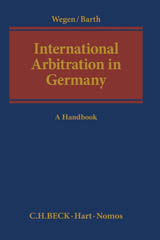
ISBN 978-3-406-63417-8
This handbook deals with arbitration cases in Germany or cases governed by German law, both ad-hoc and institutional.
The handbook covers the following issues:
- Introduction
- Legal framework for international arbitration in Germany
- Considering arbitration for disputes in Germany (Advantages of international arbitration; German institutional vs. ad-hoc arbitration; preparing for dispute in Germany)
- The arbitration agreement (Formation, scope, effect, amendment, and termination of the arbitration agreement)
- The arbitral tribunal (Jurisdiction; party autonomy; constitution of arbitral tribunal; contractual relationship between the arbitrators; rights of arbitrators; challenge of arbitrators; replacement of arbitrators)
- The arbitral procedure (The governing laws; place of arbitration and location of hearings; language of the arbitral proceedings; commencement of the arbitral proceedings; pleadings; oral hearing; default of a party; interim measures; state court assistance of arbitration; termination of arbitral proceedings)
- The arbitral award (Applicable substantive law; the making of the award; content and form; delivery; types of awards; legal effect; publication; correction, and interpretation of award)
- Settlement (Private settlement without award; award on agreed terms)
Fév 11, 2015
Données bibliographiques / Bibliografische Daten |
|---|
| Auteurs / Autoren: | NIEDERSÜß, CARL DOMINIK |
|---|
| Source / Fundstelle: | IN: Nomos, 1. Auflage 2015, Munich Intellectual Property Law Center – MIPLC, Band 24. |
|---|
| Année / Jahr: | 2015 |
|---|
| Type / Typ: | |
|---|
| Catégorie / Kategorie: | Geistiges Eigentum, Propriété intellectuelle |
|---|
| Mots clef / Schlagworte: | EUGH, Marke, MARKENSCHUTZ, CJEU, Intellectual Property, Marks |
|---|
ISBN 978-3-8487-1545-9
Traditional trade marks have become a rarity, widely replaced by more appealing means of market communication. Fueled by the CJEU's liberal jurisdiction, widening the subject matter eligible for trade mark protection, a whole new world of opportunity has opened up to advertisers.
The author adresses the question in-depth, whether a fictional character per se is eligible for trade mark protection. The topic is approached via Community and US-Supreme court jurisdiction. Furthermore, alternative means of protection via adjacent regimes are analysed. The author concludes with a thorough comparison and policy recommendations.
Content overview (Chapter III- Germany and the European Union):
- Trade mark protection
- Protection in the national German framework
- Protection in the Community Trade Mark framework
- Copyright Germany
- Unfair Competition Law Germany
- Other forms of protection
Fév 11, 2015
ISBN 978-3-8487-0302-9
This book gives a systematic comparative overview of the characteristic principles of patent enforcement proceedings in the US, Japan and Germany, ie the major jurisdictions where patent holders might seek for legal remedies in parallel proceedings.
Content overview:
- Survey
- Matter of infringement
- Fact finding
- Claims of patent holder and objections of the infringer
- Pre-procedural matters
- Infringement proceedings
- Procedural principles
(Dieses Werk ist Teil der Reihe Kooperationswerke Beck - Hart - Nomos.)
Jan 19, 2015

Cette note concerne le régime de la protection des sources des journalistes, souvent évoqué sous l'appellation de « secret des sources ». Elle prend pour base les exemples relatifs à l'Allemagne, la Belgique, les Pays-Bas, le Portugal et la Suède. Après avoir rappelé les grands traits du régime applicable en France, elle présente les conclusions de l'analyse comparative de ces cinq exemples, avant de considérer, pour les pays étudiés : la nature de la norme relative aux secrets des sources ; les bénéficiaires du régime de protection ; la portée du secret ; les garanties procédurales applicables en la matière ; et, le cas échéant, la sanction de leur violation.
Jan 14, 2015
| Données bibliographiques / Bibliografische Daten |
|---|
| Auteurs / Autoren: | SENAT- ÉTUDE DE LÉGISLATION COMPARÉE |
|---|
| Source / Fundstelle: | IN: Étude de législation comparée n° 251 - décembre 2014, http://www.senat.fr/lc/lc251/lc251_mono.html |
|---|
| Année / Jahr: | 2014 |
|---|
| Type / Typ: | |
|---|
| Catégorie / Kategorie: | Droit comparé, Droit constitutionnel, Rechtsvergleichung, Verfassungsrecht |
|---|
| Mots clef / Schlagworte: | Allgemeiner Gleichheitssatz, ALLGEMEINES GLEICHBEHANDLUNGSGESETZ, DISKRIMINIERUNGSVERBOT, Grundgesetz, LOI FONDAMENTALE, Loi générale sur l'égalité, PRINCIPE DE NON-DISCRIMINATION |
|---|
Cette note concerne le régime de la prohibition de la discrimination à raison de la pauvreté. Elle prend pour base, d'une part, des exemples d'instruments internationaux qui y font référence et, d'autre part, le régime applicable, dans huit États : l'Afrique du Sud, l'Allemagne, la Belgique, la Bolivie, l'Équateur, l'Italie, les Pays-Bas et le Royaume-Uni. Après avoir rappelé les grands traits du régime qui prévaut en France en matière de discrimination, elle présente les conclusions de l'analyse comparative de ces huit exemples (Afrique du Sud, Allemagne, Belgique, Bolivie. Équateur, Italie, Pays-Bas, Royaume-Uni) avant de considérer, pour les pays étudiés :
- la nature des normes relatives à la prohibition de la discrimination à raison de la pauvreté, lorsqu'elles existent ;
- et la définition de la pauvreté qui y est retenue.
Elle ne traite que de façon incidente des formes de sanction de la discrimination qu'elles soient civiles (nullités...) ou pénales (amendes, peines d'emprisonnement...).

